

When Does Renting AV Make More Sense Than Buying?
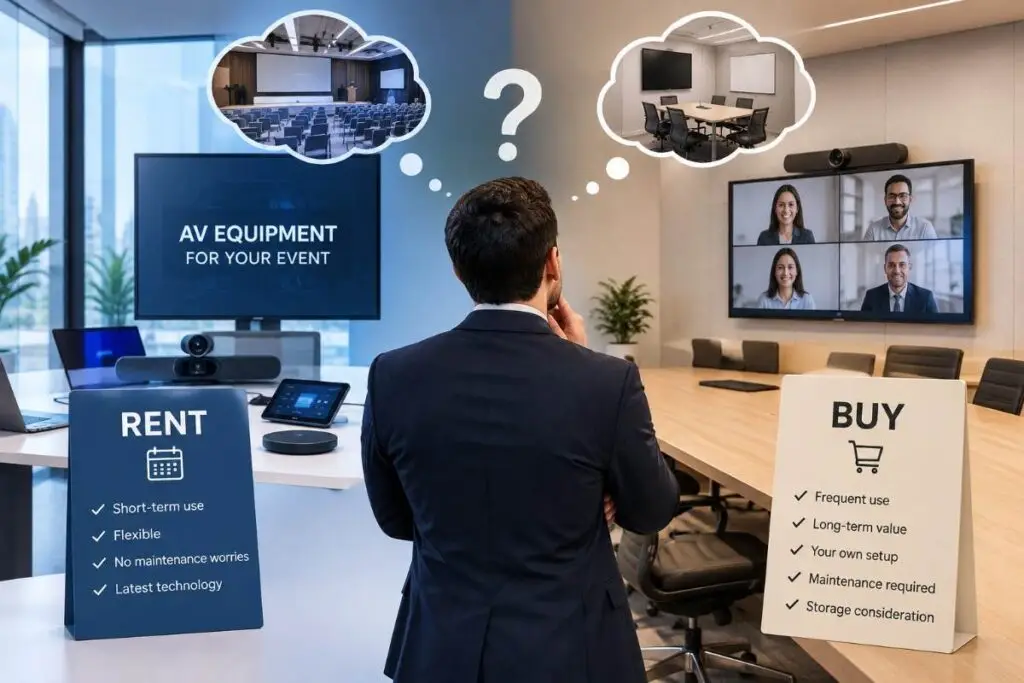
Buying professional AV equipment can feel like the obvious choice. You pay once, the equipment is yours, and you never have to worry about arranging another rental.
But what if you only need that equipment for three days?
Or what if your office is temporary? Your meeting room is being renovated? Your company is testing a new video conferencing setup? Or an important board meeting is tomorrow and your existing camera has suddenly stopped working?
That is where AV rental starts to make a lot more sense.
For businesses in the UAE, the decision between renting and buying is not simply about which option has the lower price. It depends on how often you will use the equipment, how quickly your requirements change, who will manage the technology, and how long you expect the setup to remain useful.
The right AV decision isn’t always about owning the equipment. Sometimes, it’s about having the right equipment exactly when you need it.
Rent or Buy? Start With One Simple Question
Before comparing prices, look at your actual requirement.
Ask yourself:
“Will we use this exact AV setup frequently enough to justify owning and maintaining it?”
If the answer is yes, purchasing may be the better long-term option.
If the answer is no, renting can give you professional equipment without committing your budget and resources to an asset that may spend most of its life sitting unused.
Industry guidance similarly points to usage frequency, changing technical requirements, maintenance, storage and technology lifecycle as important factors when deciding between rental and ownership.
What Does AV Rental Actually Mean?
AV rental is more than borrowing a camera or microphone for a meeting.
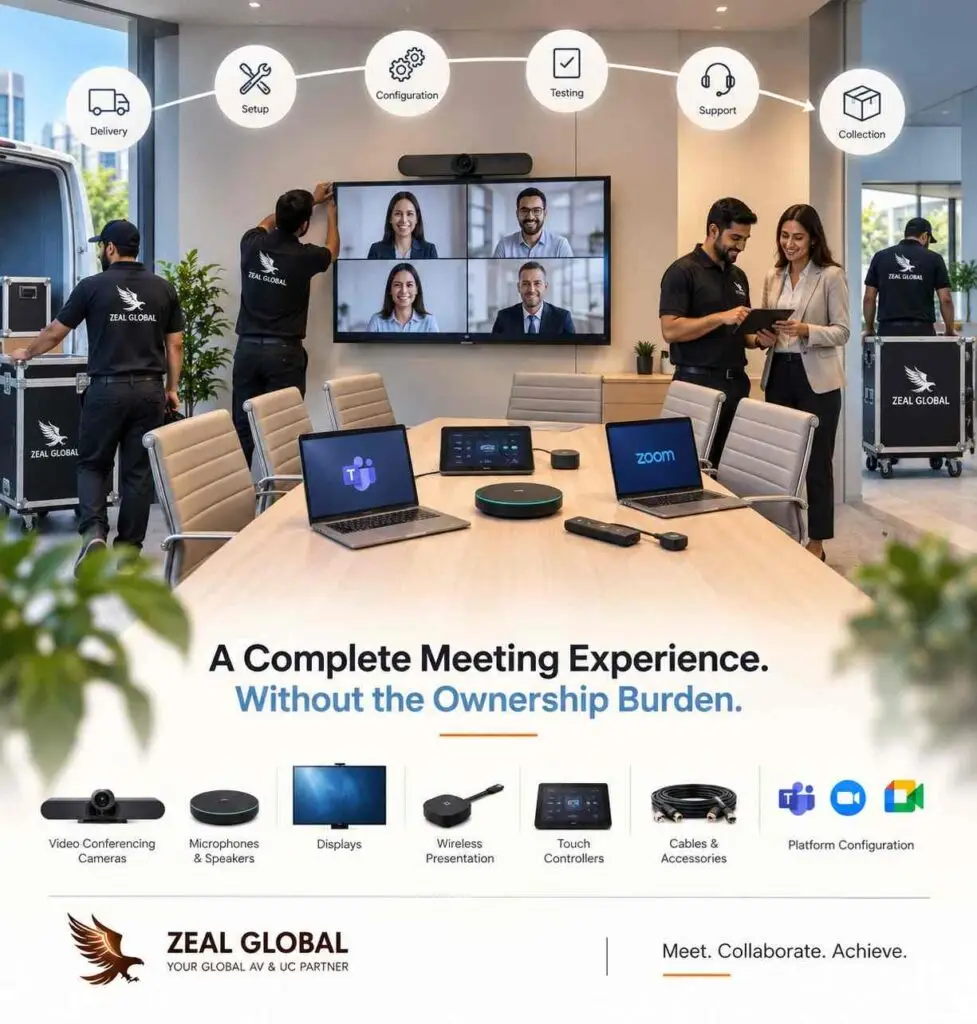
A professional AV rental service can provide the equipment, delivery, installation, configuration, testing, technical assistance and collection required for a particular period.
For a corporate meeting, that could mean:
- A video conferencing camera or all-in-one video bar
- Professional microphones and speakers
- A display or presentation screen
- Wireless presentation equipment
- Touch controllers
- Required cables and accessories
- Platform configuration for Microsoft Teams, Zoom or Google Meet
- On-site technical support, depending on the requirement
This is particularly useful when a business needs a complete meeting environment but does not want to purchase and maintain every component permanently.
7 Situations Where Renting AV Makes More Sense
This is one of the most common questions we get from remote workers, and the answer matters more in a home environment than most people realise.
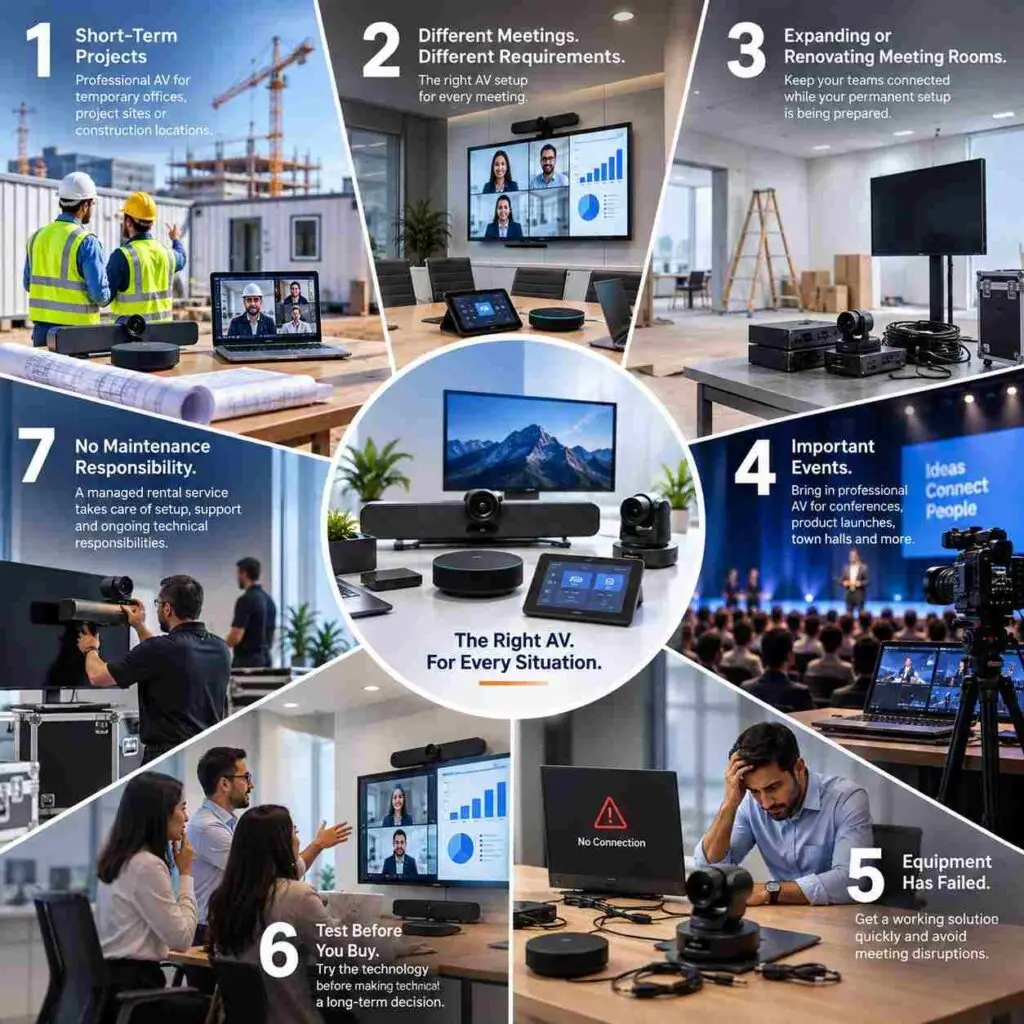
1. You Need the Equipment for a Short-Term Project
Imagine a construction company setting up a temporary project office in Dubai.
The site may need a professional meeting room so engineers can connect with headquarters, consultants can join remotely and clients can review project progress.
But the site office may only exist for the duration of the project.
Buying a complete meeting room system for a temporary location may not be the most sensible use of the company’s budget.
A rental setup can provide the required camera, audio, display and presentation technology for the project period, and the equipment can be collected when the project is complete.
The same principle applies to:
- Temporary offices
- Project locations
- Short-term branches
- Office relocation periods
- Temporary meeting spaces
- Construction site offices
If the workplace is temporary, your AV investment doesn’t necessarily need to be permanent.
2. Your AV Requirements Change From One Meeting to Another
A company may have a small internal meeting on Monday, a 20-person client presentation on Wednesday and a hybrid town hall on Friday.
The problem?
One fixed equipment setup may not be ideal for all three.
For regular team meetings and client discussions, a medium meeting room AV rental can offer a practical setup without requiring a permanent installation
Rental gives businesses the ability to choose equipment according to the actual requirements.
| Requirement | Possible Rental Setup |
|---|---|
| Small Team Meeting | Compact video bar + display |
| Client Presentation | Video conferencing + presentation system |
| Training Session | Camera + microphones + display |
| Large Board Meeting | Multiple microphones + advanced conferencing + displays |
| Hybrid Town Hall | Professional video, audio and presentation equipment |
For executive meetings, larger conferences or high-participant hybrid sessions, a large meeting room AV rental setup can provide the additional audio, video and presentation coverage required.
This flexibility becomes especially useful for companies that use different meeting spaces, host occasional corporate events or have changing participant numbers.
3. You Are Expanding or Renovating Your Meeting Rooms
Your company is adding two new meeting rooms.
The permanent AV installation is still being planned. Procurement is taking time. The fit-out is not finished.
But your teams still need to meet.
Rather than leaving the new rooms unused, a temporary AV rental can bridge the gap.
This is one of the most practical applications of rental:
Use temporary technology while permanent infrastructure is being prepared.
It can also work during:
- Office renovations
- Meeting room upgrades
- Office relocations
- Floor expansions
- Temporary workspace conversions
Once the permanent system is ready, the rental equipment can be returned.
4. You Need Professional AV for an Important Event
A company may host only a few major events each year:
- Annual general meetings
- Product launches
- Executive conferences
- Corporate workshops
- Investor presentations
- Town halls
- Leadership meetings
Buying an expensive AV setup that remains unused for most of the year may not be practical.
Renting allows the business to bring in professional equipment specifically for the event.
And there is another advantage.
You don’t have to force the event to fit whatever equipment you happen to own.
You can select the setup based on the venue, audience size, meeting format and technical requirements.
5. Your Existing Equipment Has Failed Before an Important Meeting
This is one of the situations where rental stops being a convenience and becomes a business-continuity solution.
Imagine your company’s main conference room is booked for an important client meeting tomorrow.
Then the video bar fails.
Or the microphone stops working.
Or the existing conferencing system cannot connect properly with the required platform.
Waiting for procurement, replacement or warranty support may not be an option.
A temporary rental can provide a working solution while the permanent equipment is repaired or replaced.
For an IT or office manager, the value here isn’t simply the equipment.
It’s avoiding a meeting disruption.
6. You Want to Test Before You Buy
This is one of the most overlooked reasons to rent AV equipment.
A company may be considering a new meeting room solution across multiple offices.
Instead of immediately purchasing equipment for every room, it can make sense to test the technology in a real working environment first.
For example:
Step 1: Rent a video conferencing setup for one meeting room.
Step 2: Let employees use it during actual meetings.
Step 3: Evaluate audio pickup, camera coverage, usability and platform compatibility.
Step 4: Gather feedback from IT and employees.
Step 5: Decide whether the same solution should be rolled out permanently.
A trial can reduce the risk of buying the wrong equipment for the room.
7. Your Business Doesn’t Want More AV Maintenance
Buying the equipment doesn’t end the responsibility.
Someone still needs to look after it.
That can include:
- Troubleshooting
- Firmware and software updates
- Repairs
- Replacing faulty components
- Managing cables and accessories
- Safe storage
- Equipment testing
- Configuration
- Technical support
For companies with dedicated AV or IT resources, this may be manageable.
For an SME with a small IT team, it can become another responsibility on an already busy list.
With a managed rental service, much of the operational responsibility can sit with the rental provider instead. Professional rental models commonly include equipment preparation and may also include delivery, setup and technical support depending on the service package.
AV Rental vs Buying: A Practical Comparison
| Factor | Renting AV | Buying AV |
|---|---|---|
| Initial Investment | Lower upfront commitment | Higher upfront investment |
| Usage | Ideal for temporary or occasional requirements | Best for frequent, predictable use |
| Flexibility | Easy to change equipment based on requirements | Limited to equipment already owned |
| Maintenance | Usually handled by the provider under the rental service | Business is responsible |
| Storage | No long-term storage requirement | Equipment must be stored securely |
| Technology Upgrades | Easier access to newer equipment | Upgrade requires another investment |
| Technical Support | Can be included in rental package | Usually needs internal staff or separate support |
| Scalability | Easy to increase or reduce equipment | Limited by existing inventory |
| Ownership | No asset ownership | Business owns the equipment |
| Long-Term Economics | Can become expensive with continuous use | Can be more economical with frequent use |
When Buying AV Equipment Is the Better Choice
Rental isn’t always the smarter option.
If your company has a permanent meeting room that is used every day, with the same equipment and predictable requirements, buying can make more sense.
For example, consider a dedicated corporate boardroom that is used for executive meetings every working day.
The company may need:
- The same camera
- The same microphones
- The same display
- The same conferencing platform
- Immediate access without coordinating availability
In this situation, ownership provides control and continuous availability.
Buying can also make sense when:
You use the equipment frequently
If the same setup is used continuously, repeated rental costs can eventually outweigh the benefits of renting.
You have permanent infrastructure
A fixed boardroom with custom cabling, displays, control systems and integrated AV infrastructure is usually designed as a long-term installation.
You have the expertise to manage it
A company with dedicated technical staff may be perfectly comfortable handling maintenance, troubleshooting and upgrades.
Your requirements are unlikely to change
If the technology is stable, the room configuration is fixed and the business expects to use the system for years, ownership deserves serious consideration.
As recent AV guidance also notes, buying can be attractive when equipment is used constantly and the business has the capital and capability to manage the technology over its lifecycle.
5 Questions to Ask Before You Decide
Still unsure?
Don’t start with the equipment catalogue. Start with these five questions.
1. How often will we actually use it?
Daily? Weekly? A few times a year?
The more frequently the equipment is used, the stronger the case for ownership.
2. Is the requirement temporary?
If the project, office, event or meeting space has a defined end date, rental deserves serious consideration.
3. Will the technology or room requirement change?
If you expect your meeting rooms, team size or technology requirements to evolve, flexibility can be more valuable than ownership.
4. Who will manage the equipment?
If there is no one internally who can troubleshoot the system, a managed rental solution can reduce the technical burden.
5. What happens if the equipment fails?
For a normal internal meeting, downtime may be inconvenient.
For a board meeting, investor presentation or important client call, it can affect the entire business conversation.
Your decision should account for that risk too.
A Simple Example: Rent or Buy?
Let’s say a UAE company needs additional AV equipment for a temporary six-month project office.
The company could purchase the equipment, manage installation, maintain it and eventually decide what to do with it when the project ends.
Or it could rent a suitable setup for six months, with delivery, installation, support and collection included according to the rental agreement.
The second option may offer greater flexibility.
Now change the scenario.
The company has a permanent headquarters with three meeting rooms used every day for internal and external meetings.
The same AV configuration is required throughout the year.
Here, purchasing may be the more logical long-term decision.
Same technology. Two completely different answers.
That’s why “Should we rent or buy?” cannot be answered by price alone.
So, Should Your Business Rent or Buy?
Here’s the simplest way to think about it.
Rental may be the better fit if you:
- Need AV equipment for a short-term project.
- Are setting up a temporary office or construction site office.
- Are expanding or renovating meeting rooms.
- Host occasional conferences, workshops or corporate events.
- Need emergency replacement equipment.
- Want to test technology before committing to a purchase.
- Need different equipment for different meeting requirements.
- Want professional setup and support without managing the equipment yourself.
Buying may be the better fit if you:
- Use the same AV system every day.
- Have permanent meeting rooms.
- Have predictable, long-term requirements.
- Have internal technical expertise.
- Need immediate access to your own equipment at all times.
- Have compared the long-term ownership cost and found it more economical.
The key is to match the AV model to the business requirement, not the other way around.
Need AV for a Meeting Without Buying the Equipment?
If you’re unsure whether to rent or buy, or which setup would work best for your room and participant count, a meeting room consultation can help you evaluate the options before making a decision
Zeal Global provides meeting room AV rental solutions across the UAE, including equipment selection, delivery, setup, testing and technical support based on the rental requirement
Need help deciding whether to rent or buy? Start with a consultation.